

Xinying Hou
xinying.hou [at] njit [dot] edu
Department of Data Science
College of Computing
New Jersey Institute of Technology
Newark, NJ
News
09/2026Delighted to begin my journey as a tenure-track Assistant Professor at NJIT!
06/2026Successfully defended my PhD, it's Dr. Hou now!
04/2026One full paper has been accepted to ICER 2026!
03/2026Our full-day workshop ALIT4ALL: 2nd International Workshop on AI Literacy Education For All has been accepted to AIED 2026!
02/2026Three papers have been accepted to ISLS 2026!
Selected Publications
Check my Google Scholar profile for a full list of publications and see who's citing them!
* Equal Contribution
Underlined names indicate that I contributed in a mentoring capacity
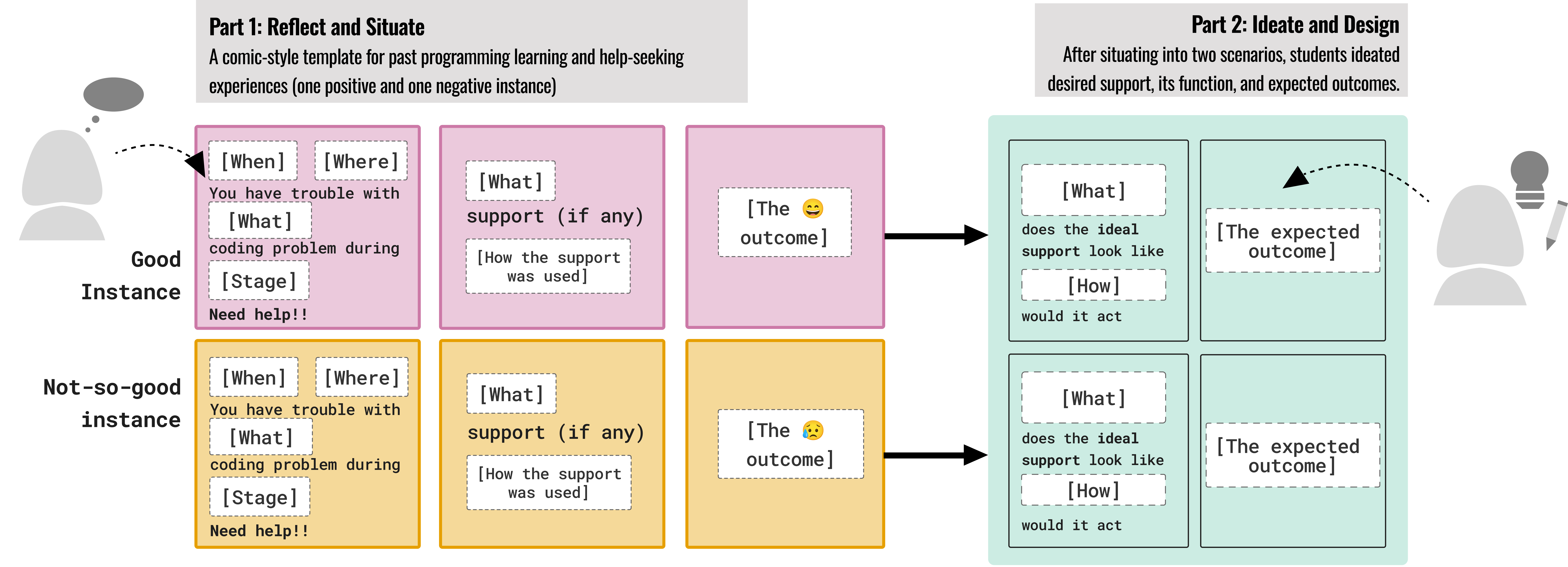
Designing Desired Support for Learning Programming with Minoritized Women Students in Computing
ICER 2026: The ACM Conference on International Computing Education Research
There are growing efforts to increase the percentage of secondary students who take computing courses.
However, U.S. women identifying as Black/African American, Hispanic/Latina, and/or Native American remain underrepresented in computing and face persistent challenges in learning to program.
Moreover, it remains underexplored what types of programming learning support minoritized high school women desire. To address this gap, this study investigates the challenges minoritized high school women encounter in current helpseeking practices and explores the forms of programming learning
support they desire. We conducted design sessions with 12 high school women who are minoritized in computing and enrolled in Advanced Placement Computer Science courses. Using thematic analysis, we examined the challenges they encountered with existing help-seeking resources, as well as their preferred format and support features.
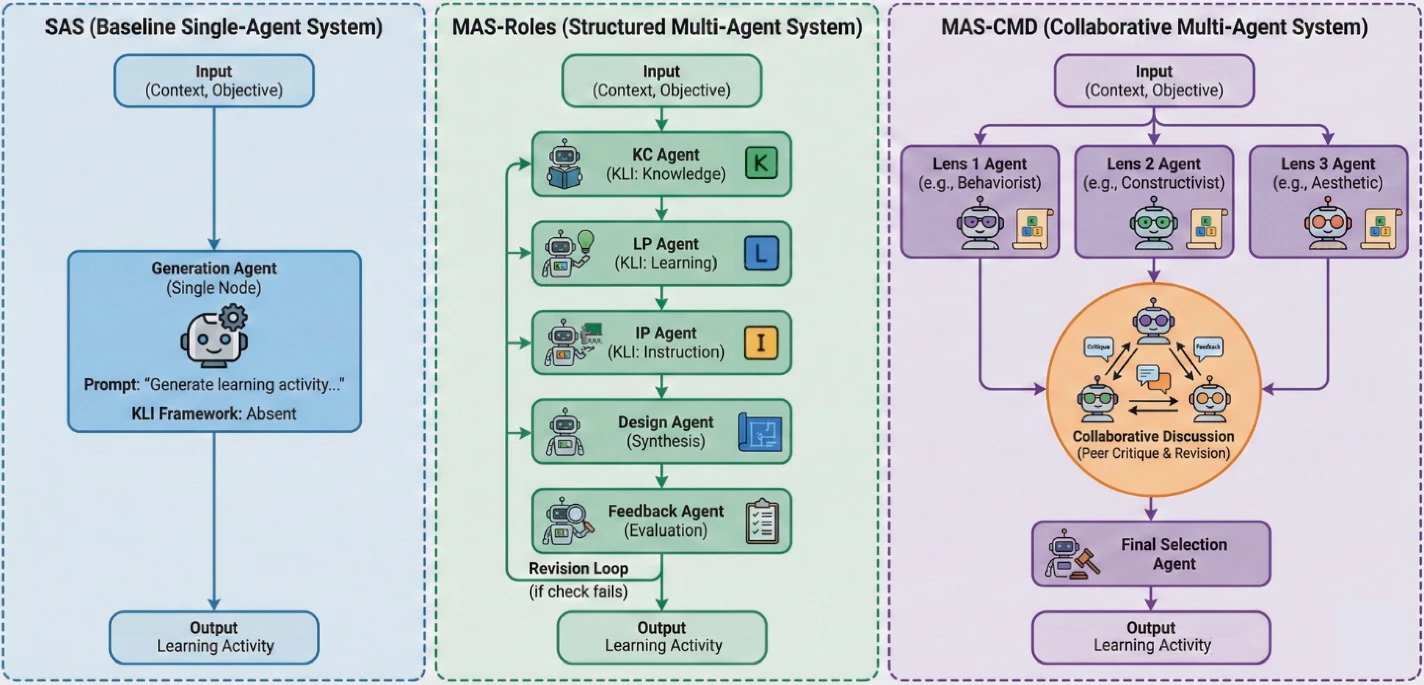
Enabling Multi-Agent Systems as Learning Designers: Applying Learning Sciences to AI Instructional Design
AIED 2026: International Conference on Artificial Intelligence in Education
As AI enters computer science (CS) education, novices need early opportunities to strengthen code understanding. This work responds to this need by investigating pairing mixed-up code puzzles (Parsons puzzles) with self-explanation (SE) prompts. Drawing on learning sciences work, we designed two SE prompts: Select, where students engage in SE by choosing correct options, and Fill, where they engage in SE by typing answers. In an in-depth within-subjects study (N=10), all novices valued SE prompts for understanding code after solving puzzles. Select was strongly preferred to Fill for its efficiency and scaffolding. Fill was removed due to frustration from likely non-learning mental effort. A between-subjects study (N=110) in an intro-level CS classroom compared practice with puzzles-only to puzzles plus Select SEs. The group solving puzzles with Select showed significantly greater pre-to- posttest learning gains with similar perceived in-practice mental effort.
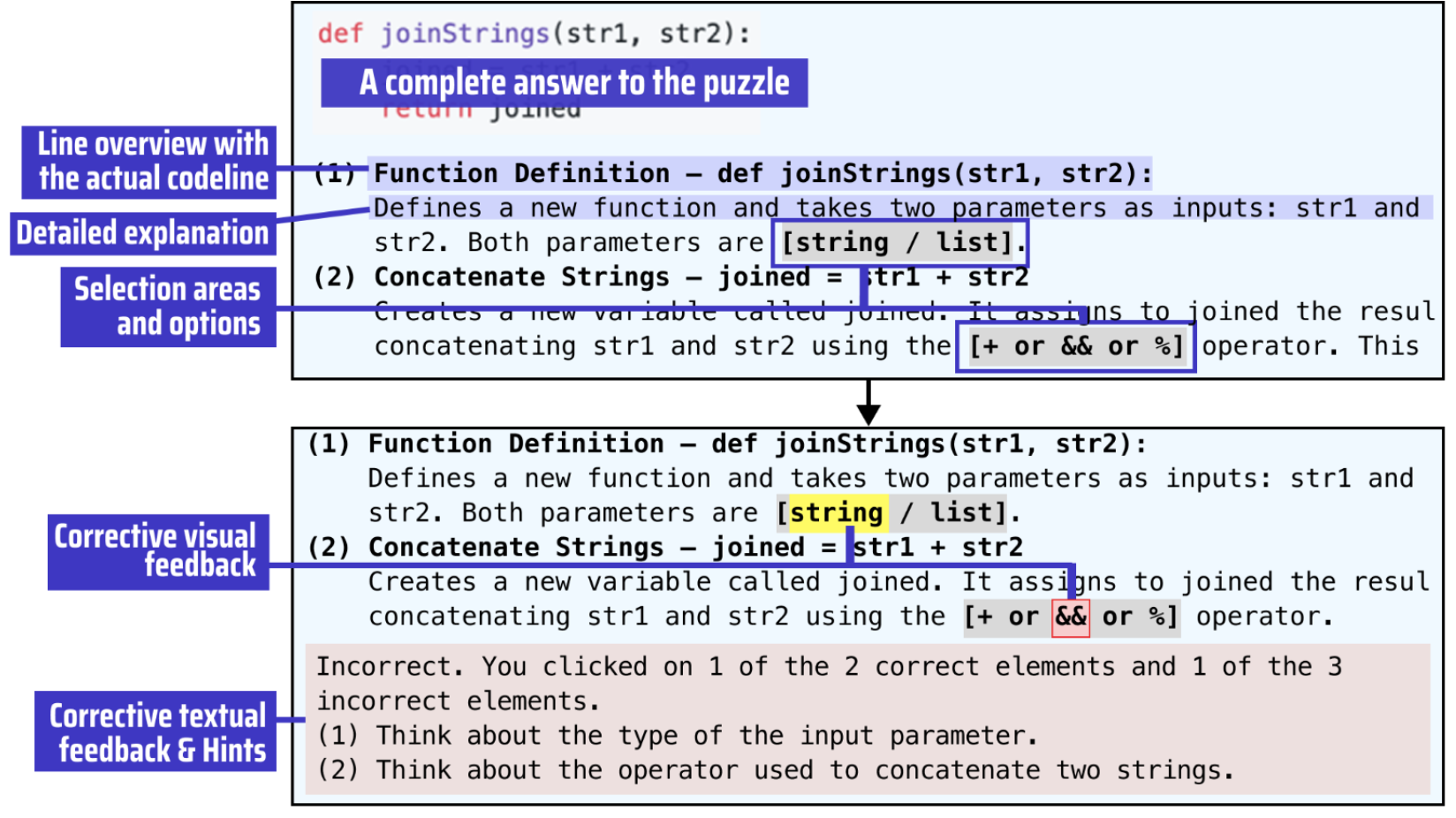
Enhance Code Understanding through Prompted Self-Explanation with Mixed-Up Code Puzzles: Novice Preferences and Outcomes
ICLS 2026: International Conference of the Learning Sciences
As AI enters computer science (CS) education, novices need early opportunities to strengthen code understanding. This work responds to this need by investigating pairing mixed-up code puzzles (Parsons puzzles) with self-explanation (SE) prompts. Drawing on learning sciences work, we designed two SE prompts: Select, where students engage in SE by choosing correct options, and Fill, where they engage in SE by typing answers. In an in-depth within-subjects study (N=10), all novices valued SE prompts for understanding code after solving puzzles. Select was strongly preferred to Fill for its efficiency and scaffolding. Fill was removed due to frustration from likely non-learning mental effort. A between-subjects study (N=110) in an intro-level CS classroom compared practice with puzzles-only to puzzles plus Select SEs. The group solving puzzles with Select showed significantly greater pre-to- posttest learning gains with similar perceived in-practice mental effort.
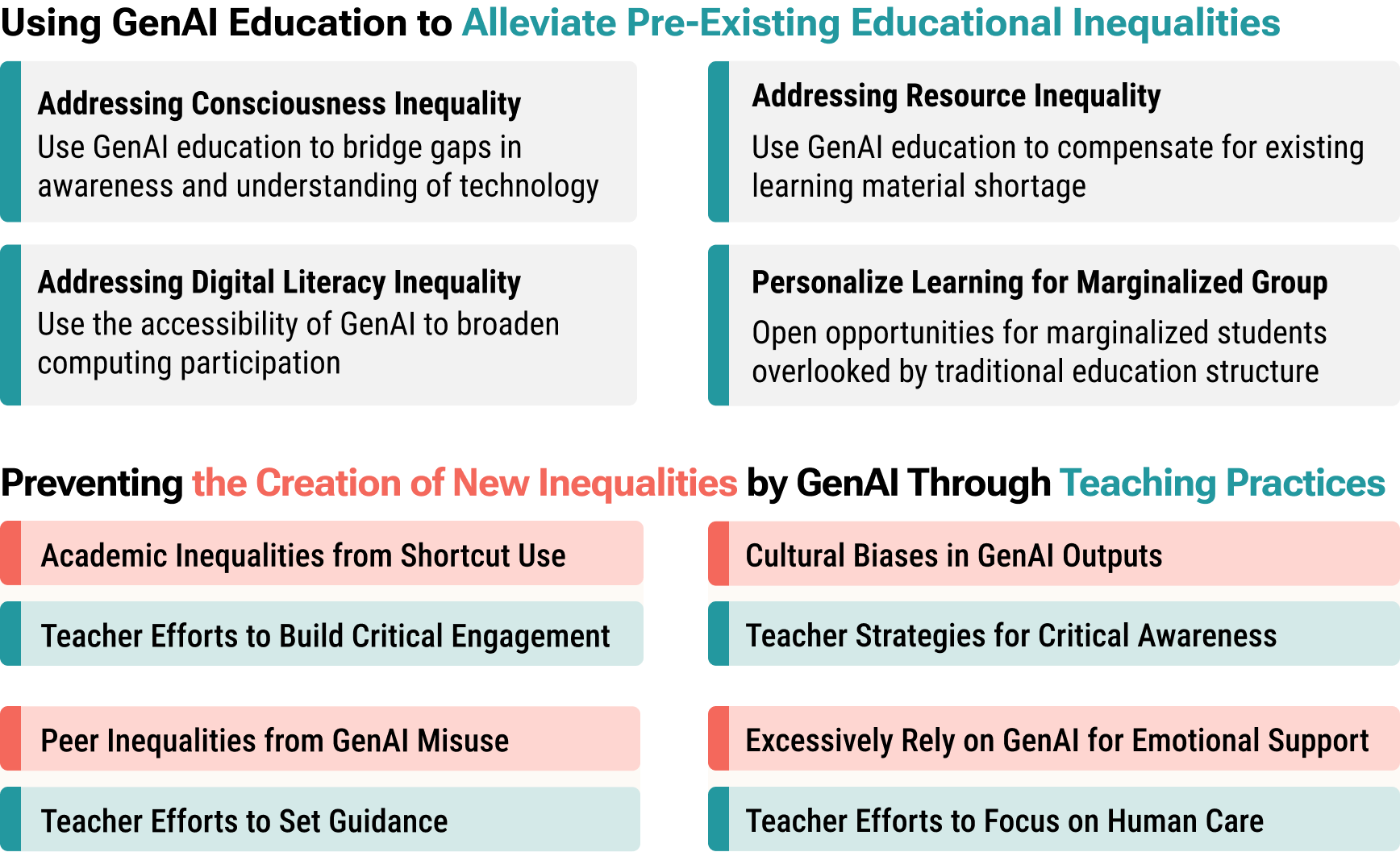
Do Teachers Dream of GenAI Widening Educational (In) equality? Envisioning the Future of K-12 GenAI Education from Global Teachers' Perspectives
CHI 2026: The ACM CHI conference on Human Factors in Computing Systems
Generative artificial intelligence (GenAI) is rapidly entering K-12 classrooms worldwide, initiating urgent debates about its potential to either reduce or exacerbate educational inequalities. Drawing on interviews with 30 K-12 teachers across the United States, South Africa, and Taiwan, this study examines how teachers navigate this GenAI tension around educational equalities.
We found teachers actively framed GenAI education as an equality-oriented practice: they used it to alleviate pre-existing inequalities while simultaneously working to prevent new inequalities from emerging. Despite these efforts, teachers confronted persistent systemic barriers, i.e., unequal infrastructure, insufficient professional training, and restrictive social norms, that individual initiative alone could not overcome.
Teachers thus articulated normative visions for more inclusive GenAI education. By centering teachers’ practices, constraints, and future envisions, this study contributes a global account of how GenAI education is being integrated into K-12 contexts and highlights what is required to make its adoption genuinely equal.
An LLM-Enhanced Multi-agent Architecture for Conversation-Based Assessment
AIED 2025: International Conference on Artificial Intelligence in Education
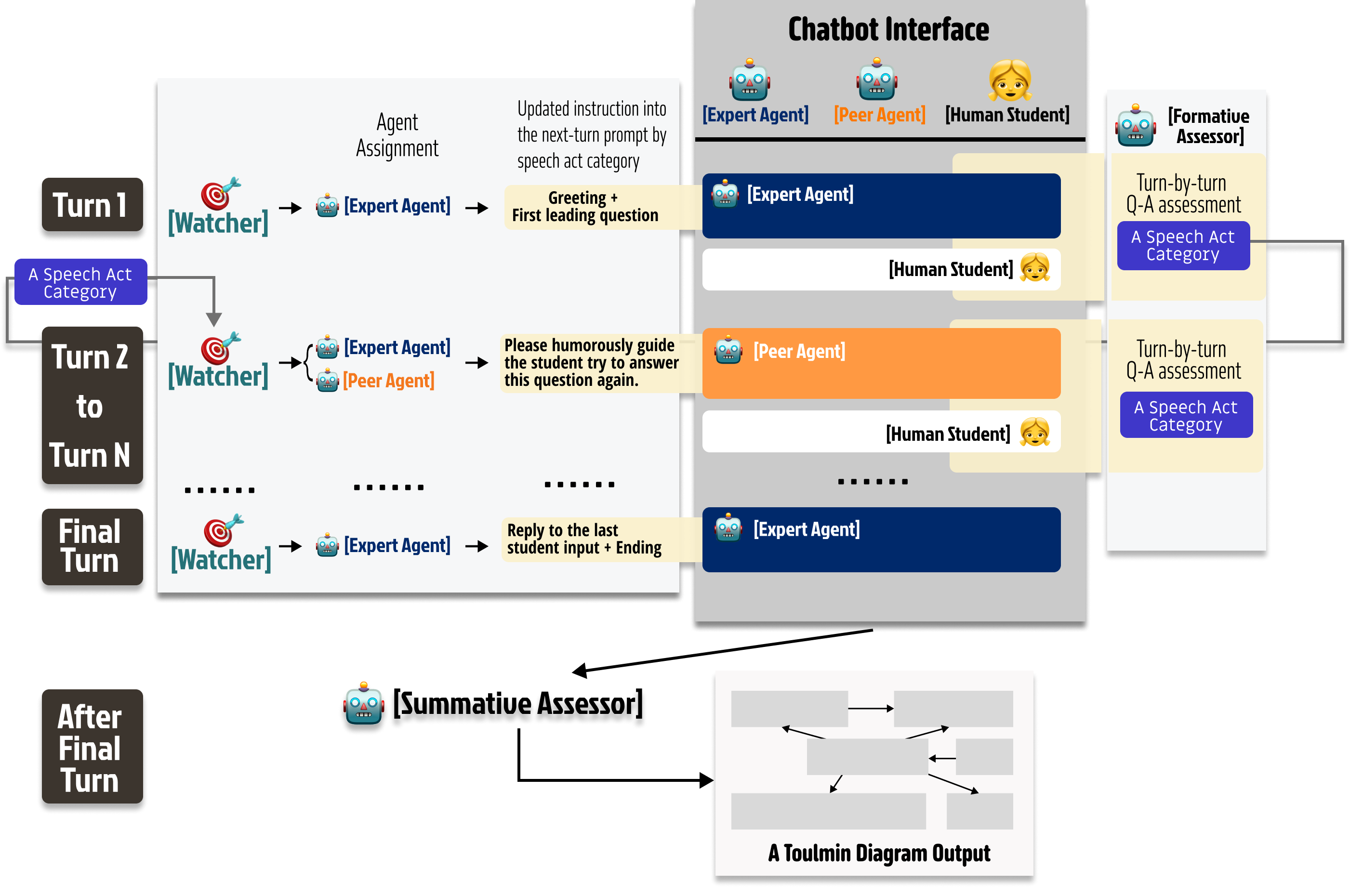
Conversation-based assessments (CBA), which evaluate student knowledge through interactive dialogues with artificial agents on a given topic, can help address non-effortful formative test-taking and the lack of adaptability in traditional assessment. This work employs evidence-centered design framework with LLM techniques to establish a multi-agent architecture for conversation-based assessment. It includes four LLM agents: two student-facing agents and two behind-the-scenes agents. All agents are monitored by a non-LLM agent (Watcher), which manages the assessment flow through updated instructions to agents and turn control.
Exploring Student Choice and the Use of Multimodal Generative AI in Programming Learning
SIGCSE 2025: The 57th ACM Technical Symposium on Computer Science Education
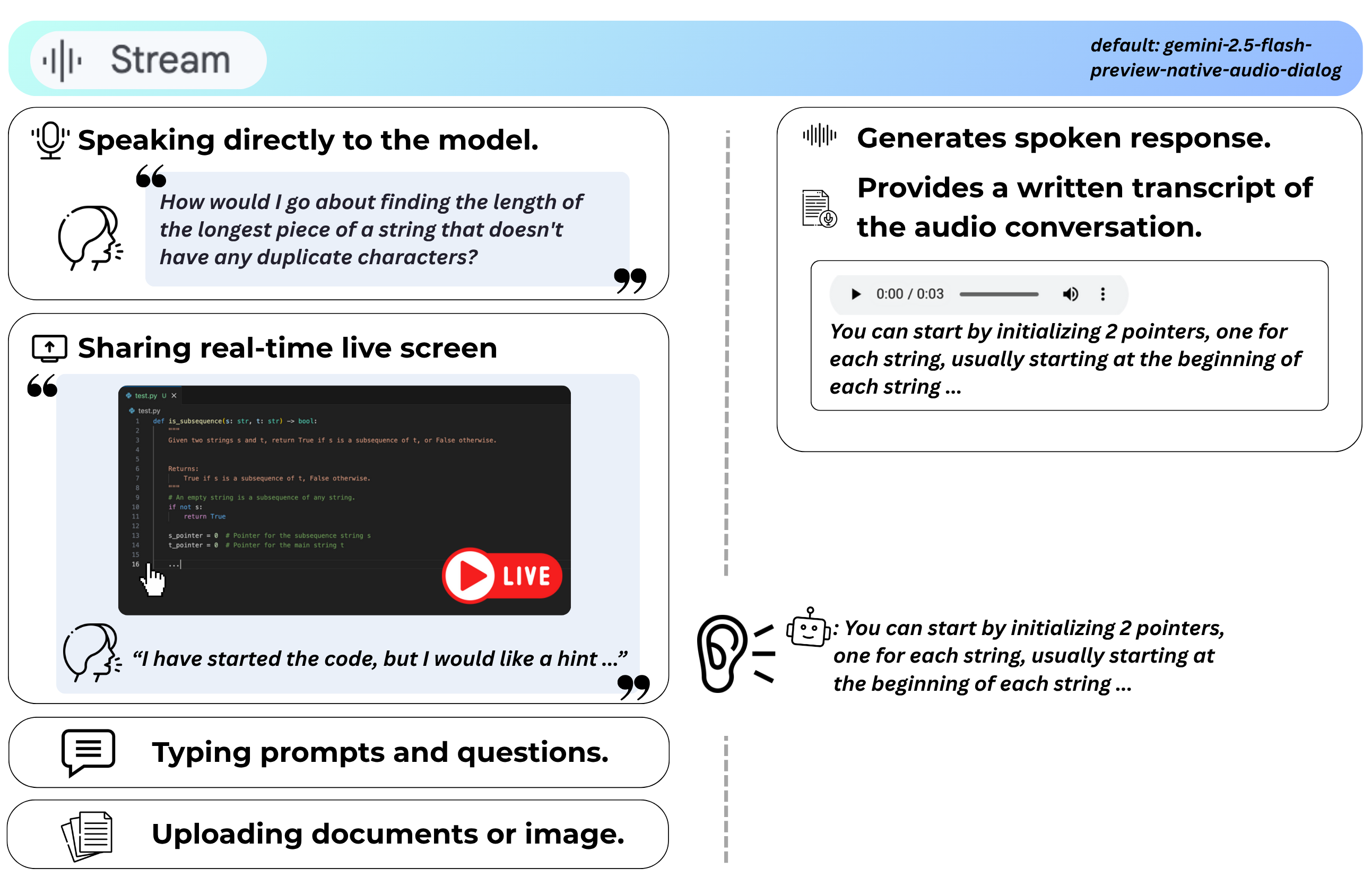
With recent developments, GenAI applications have begun supporting multiple modes of communication, known as multimodality. In this work, we explored how undergraduate programming novices choose and work with multimodal GenAI tools, and their criteria for choices. We selected a commercially available multimodal GenAI platform for interaction, as it supports multiple input and output modalities, including text, audio, image upload, and real-time screen-sharing. Through 16 think-aloud sessions that combined participant observation with follow-up semi-structured interviews, we investigated student modality choices for GenAI tools when completing programming problems and the underlying criteria for modality selections.
Improving Student-AI Interaction Through Pedagogical Prompting: An Example in Computer Science Education
Under Revision
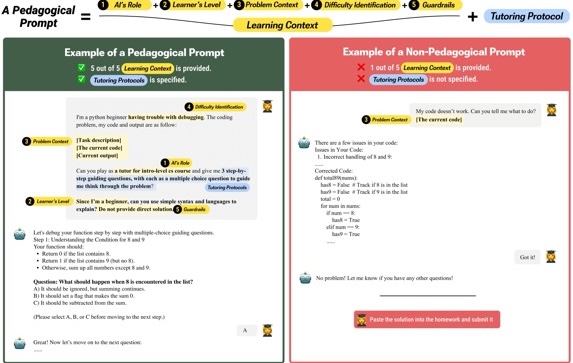
We first proposed pedagogical prompting, a theoretically-grounded new concept to elicit learning-oriented responses from LLMs.
For proof-of-concept learning intervention in a real educational setting, we selected early undergraduate
CS education (CS1/CS2) as the example context. Based on instructor insights, we designed and developed a learning
intervention as an interactive system with scenario-based instruction to train pedagogical prompting
skills. Finally, we assessed its effectiveness with pre/post-tests in a user study of CS undergraduates.
CodeTailor: LLM-Powered Personalized Parsons Puzzles for Engaging Support While Learning Programming
L@S 2024: ACM Conference on Learning @ Scale
🏅 Best Paper Nomination
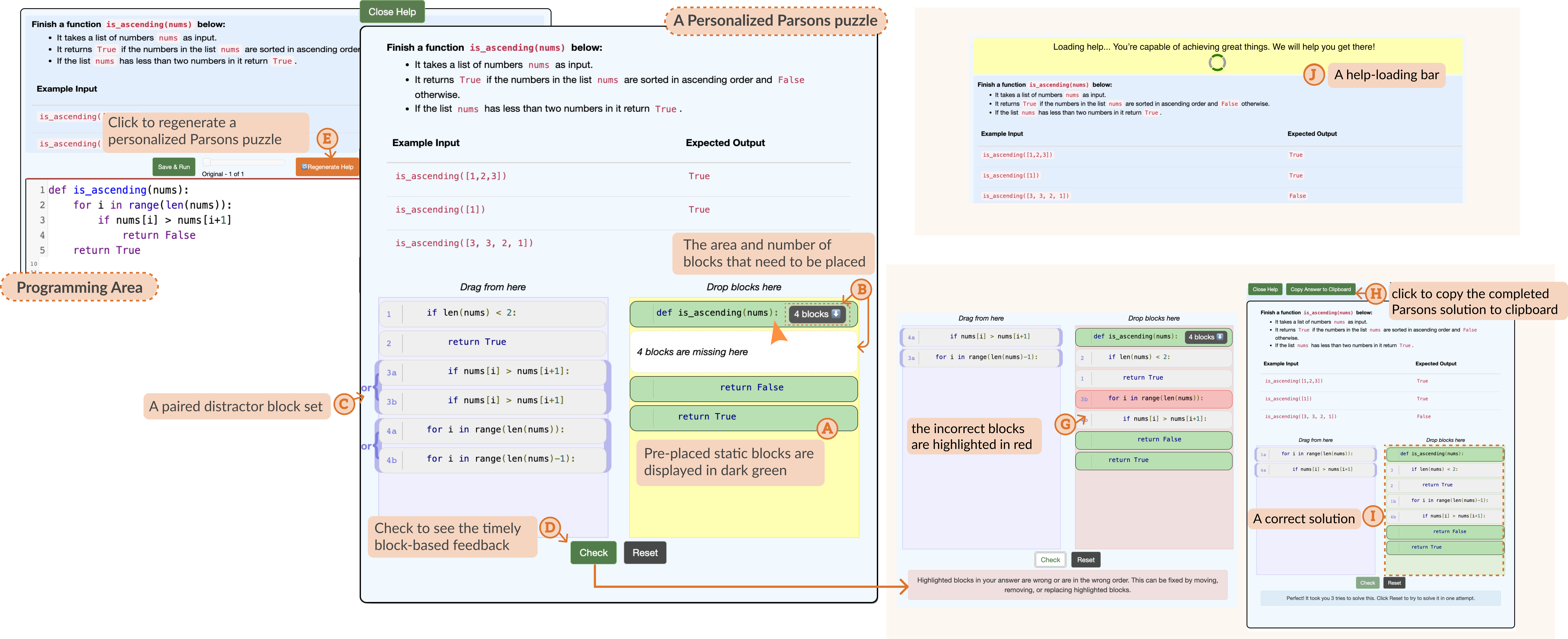
We presented CodeTailor, a system that leverages a large language model (LLM) to provide personalized help to students while still encouraging cognitive engagement. CodeTailor provides a personalized Parsons puzzle to support struggling students. In a Parsons puzzle, students place mixed-up code blocks in the correct order to solve a problem.
CodeTailor distinguishes itself from existing LLM-based products by providing an
active learning opportunity where students are expected to "solve"
the puzzle rather than simply acting as passive consumers by "read-
ing" a direct solution.
How novices use LLM-based code generators to solve CS1 coding tasks in a self-paced learning environment
Koli Calling 2023: ACM Koli Calling International Conference on Computing Education Research
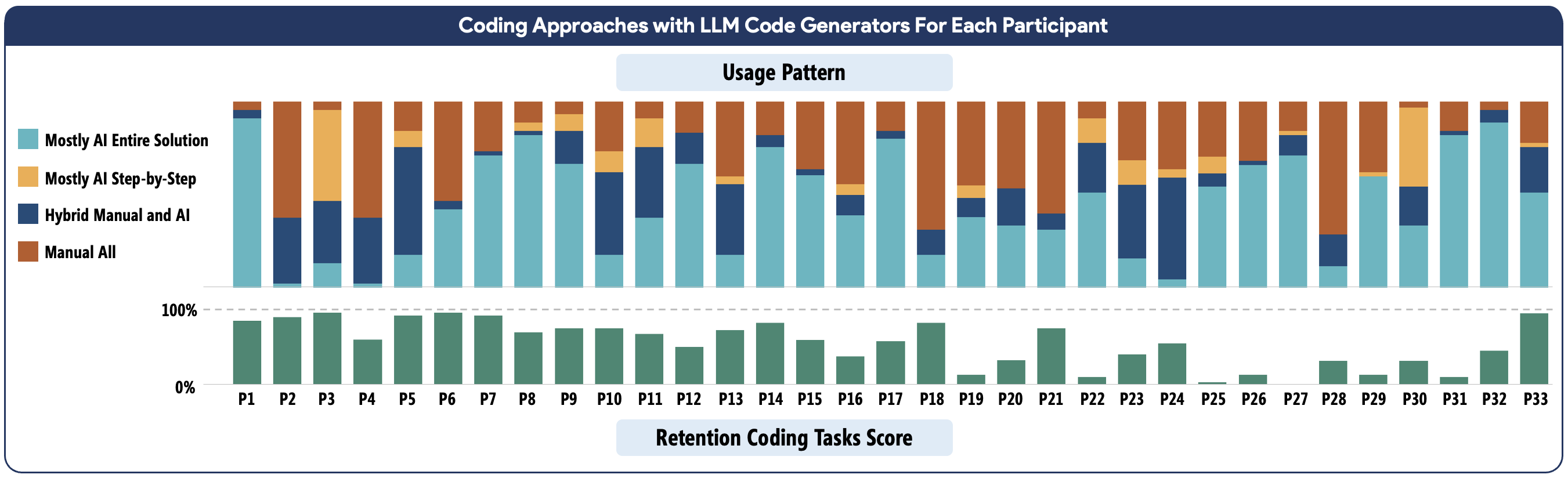
We presented the results of a thematic analysis on a data set from 33 learners as they independently learned Python by working on 45 code-authoring tasks with access to an AI Code Generator based on OpenAI Codex. Our analysis reveals four distinct coding approaches when writing code with an AI code generator: AI Single Prompt; AI Step-by-Step; Hybrid; and Manual coding, where learners wrote the code themselves.
Using Adaptive Parsons Problems to Scaffold Write-code Problems
ICER 2022: ACM Conference on International Computing Education Research
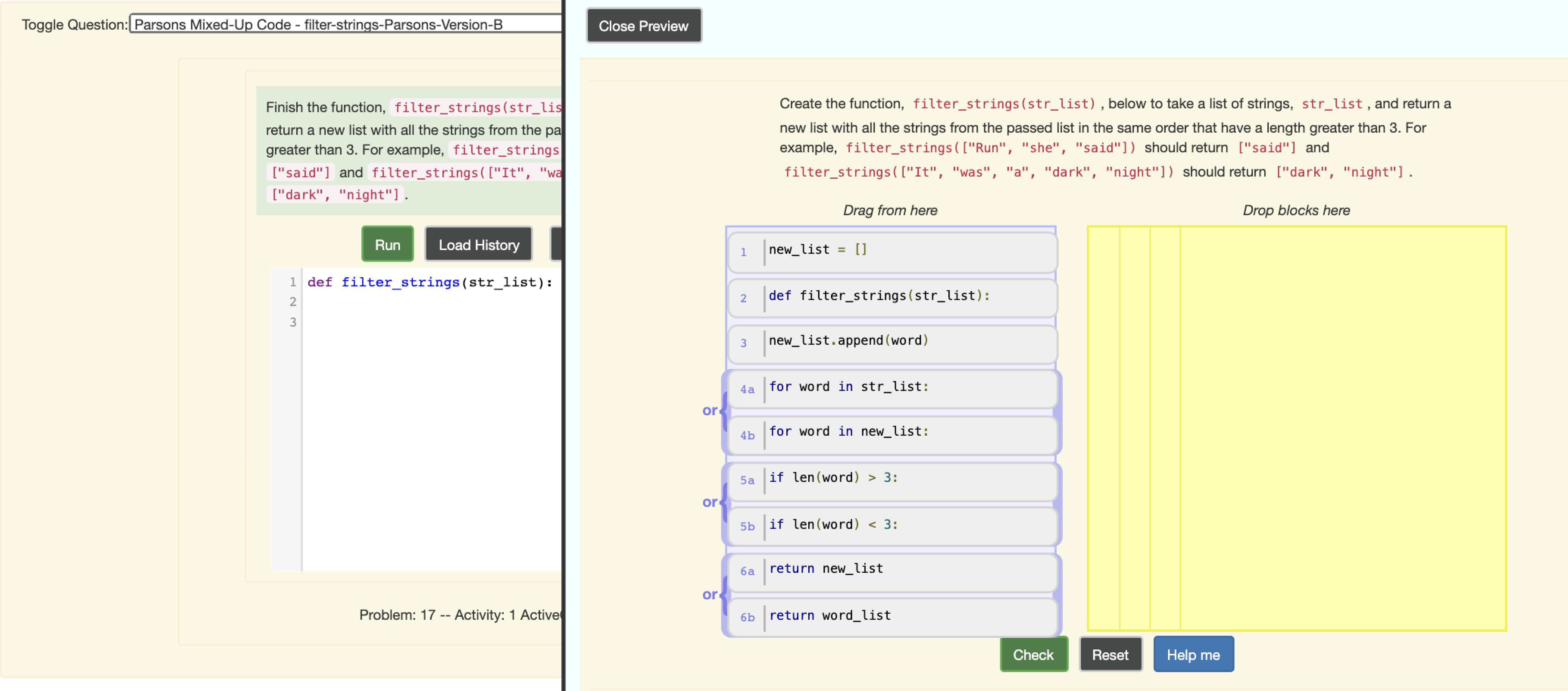
In this paper, we explore using Parsons problems to scaffold novice programmers who are struggling while solving write-code problems. Parsons problems, in which students put mixed-up code blocks in order, can be created quickly and already serve thousands of students while other types of programming support methods are expensive to develop or do not scale. We conducted studies in which novices were given equivalent Parsons problems as optional scaffolding while solving write-code problems. We investigated when, why, and how students used the Parsons problems as well as their perceptions of the benefits and challenges.
Assessing the effects of open models of learning and enjoyment in a digital learning game
IJAIED: International Journal of Artificial Intelligence in Education
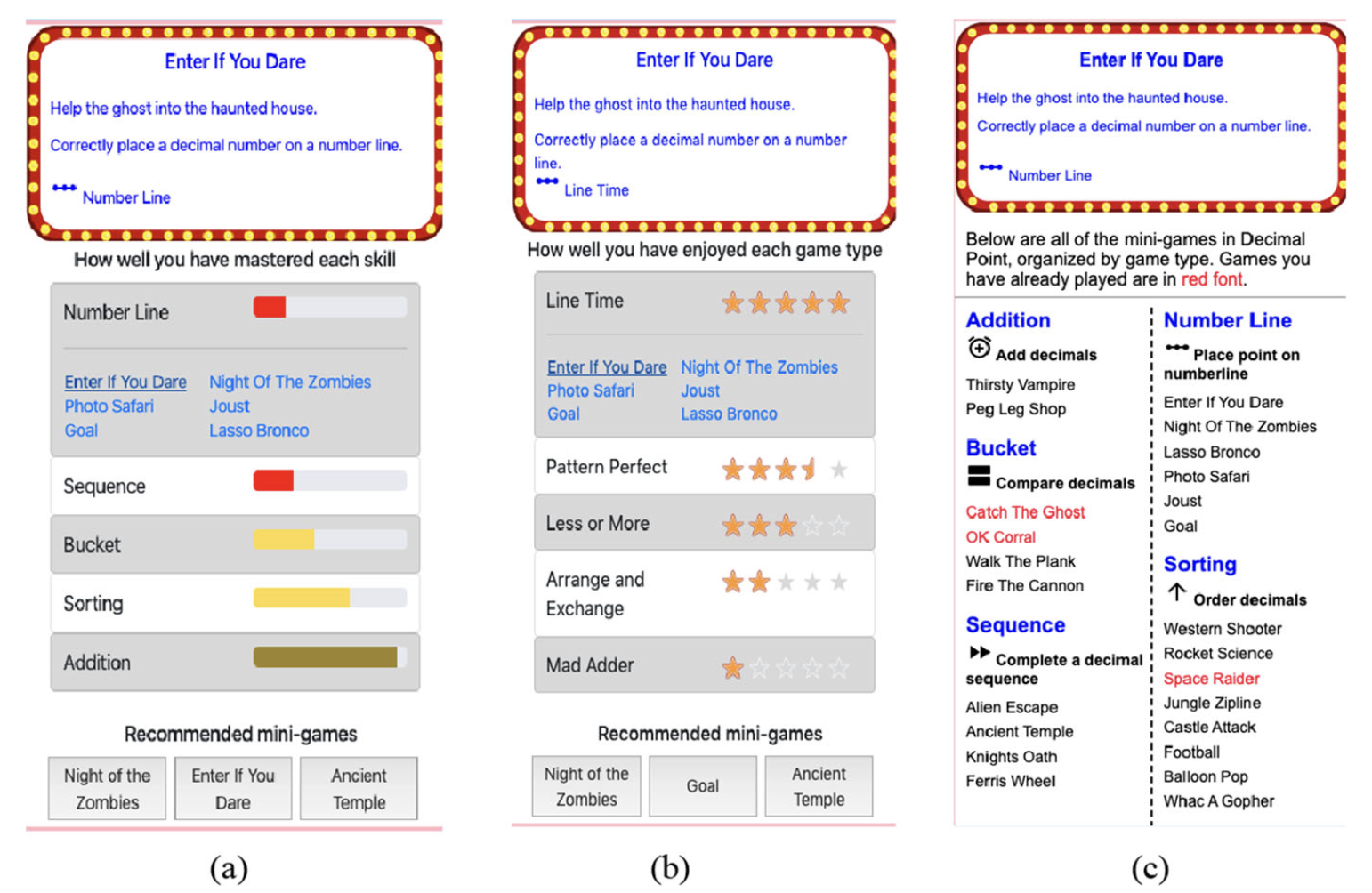
In this math digital learning game, one version encouraged playing and learning through an open learner model, while one encouraged playing for enjoyment through an analogous open enjoyment model.
We compared these versions to a control version that is neutral with respect to learning and enjoyment. The learning-oriented group engaged
more in re-practicing, while the enjoyment-oriented group demonstrated more exploration of different mini-games. In turn, our analyses have led
to preliminary ideas about how to use AI to provide recommendations that are more
aligned with students’ dynamic learning and enjoyment states and preferences.